The Zealot and the Emancipator by H. W. Brands
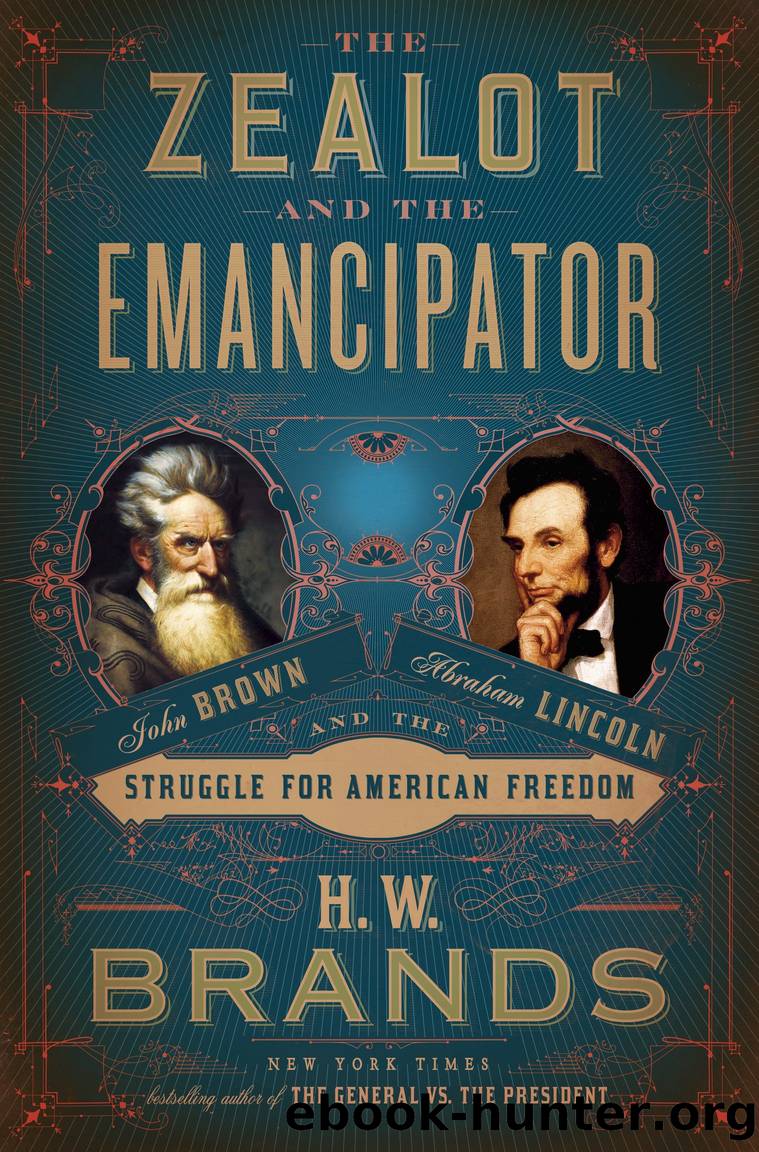
Author:H. W. Brands [Brands, H. W.]
Language: eng
Format: epub
Publisher: Knopf Doubleday Publishing Group
Published: 2020-10-06T00:00:00+00:00
* * *
â
THE QUESTION OF Brownâs sanity exercised nearly everyone involved in the slavery debate. Many Southerners had long deemed abolitionists mad for trying to overturn the Southâs beneficent institution, or if not certifiably mad, then hysterical in the lengths to which they took their false altruism. Other Southerners, though, reckoned that imputations of insanity would let the North off too easily. They contended that actions like Brownâs were the all-too-logical consequence of allowing the abolitionists a place at the political table.
The Republican party had a special interest in Brown. From nothing in 1854 the Republicans had become the equals of the Democrats, whose lineage ran back to Thomas Jefferson. Their first presidential candidate, John Frémont, had come close to winning the White House; their next candidate would have an even better chance, unless something unforeseen occurred.
Brownâs attack on Harpers Ferry might be just that something. Republicans at once took cover. âWe are damnably exercised about the effect of Old Brownâs wretched fiasco in Virginia upon the health of the Republican party!â a Chicago Republican wrote to Abraham Lincoln. âThe old idiotâthe quicker they hang him and get him out of the way, the better.â Republicans in Chicago were contending that Brown had nothing to do with them. âYou see how we treat it,â Lincolnâs correspondent continued. âI hope we occupy the right ground.â
Some Republicans had trouble getting out of the way. William Seward was the best known of the Republicans, having been a senator from New York for a decade, starting with the Whig party. Antislavery sentiments sat well with New York voters, and Seward had indulged himself on numerous occasions, including his first speech in the Senate, in which he bearded the lions of the Whig party, Henry Clay and Daniel Webster. Clay and Webster contended that the Constitution required what they were proposing as the Compromise of 1850; Seward rejoined that there was âa higher law than the Constitution.â Sewardâs assertion didnât scuttle the compromise, yet it helped torpedo the Whig party. And it put him at the head of Republicans looking toward the White House as the 1860 election approached.
But it also made him vulnerable to charges that his âhigher lawâ was exactly what extremists like John Brown appealed to, and that Seward would do to the Republicans what he had already done to the Whigs. Some in the party chafed at evidence that Seward was already awarding himself the nomination. âHe has forgotten everything else, even that he is a senator and has duties as such,â one of his Senate colleagues, a Maine Republican, asserted, adding that Seward affected âthe airs of a president.â
Sewardâs opponents allowed themselves to imagine that John Brown could save the party rather than wreck it, by denying Seward the nomination. âSince the humbug insurrection at Harperâs Ferry, I presume Mr. Seward will not be urged,â a Pennsylvania Republican wrote hopefully to Lincoln.
Download
This site does not store any files on its server. We only index and link to content provided by other sites. Please contact the content providers to delete copyright contents if any and email us, we'll remove relevant links or contents immediately.
| Africa | Americas |
| Arctic & Antarctica | Asia |
| Australia & Oceania | Europe |
| Middle East | Russia |
| United States | World |
| Ancient Civilizations | Military |
| Historical Study & Educational Resources |
The Dawn of Everything by David Graeber & David Wengrow(1707)
The Bomber Mafia by Malcolm Gladwell(1622)
Facing the Mountain by Daniel James Brown(1553)
Submerged Prehistory by Benjamin Jonathan; & Clive Bonsall & Catriona Pickard & Anders Fischer(1455)
Wandering in Strange Lands by Morgan Jerkins(1430)
Tip Top by Bill James(1416)
Driving While Brown: Sheriff Joe Arpaio Versus the Latino Resistance by Terry Greene Sterling & Jude Joffe-Block(1376)
Red Roulette : An Insider's Story of Wealth, Power, Corruption, and Vengeance in Today's China (9781982156176) by Shum Desmond(1359)
Evil Geniuses: The Unmaking of America: A Recent History by Kurt Andersen(1353)
The Way of Fire and Ice: The Living Tradition of Norse Paganism by Ryan Smith(1336)
American Kompromat by Craig Unger(1315)
F*cking History by The Captain(1303)
It Was All a Lie by Stuart Stevens;(1300)
American Dreams by Unknown(1286)
Treasure Islands: Tax Havens and the Men who Stole the World by Nicholas Shaxson(1272)
Evil Geniuses by Kurt Andersen(1257)
White House Inc. by Dan Alexander(1212)
The First Conspiracy by Brad Meltzer & Josh Mensch(1174)
The Fifteen Biggest Lies about the Economy: And Everything Else the Right Doesn't Want You to Know about Taxes, Jobs, and Corporate America by Joshua Holland(1126)
